Showing posts with label Writing. Show all posts

Monday

Monday - Billy Collins 


The birds are in their trees,
the toast is in the toaster,
and the poets are at their windows.

They are at their windows
in every section of the tangerine of earth-
the Chinese poets looking up at the moon,
the American poets gazing out
at the pink and blue ribbons of sunrise.

The clerks are at their desks,
the miners are down in their mines,
and the poets are looking out their windows
maybe with a cigarette, a cup of tea,
and maybe a flannel shirt or bathrobe is involved.

The proofreaders are playing the ping-pong
game of proofreading,
glancing back and forth from page to page,
the chefs are dicing celery and potatoes,
and the poets are at their windows
because it is their job for which
they are paid nothing every Friday afternoon.

Which window it hardly seems to matter
though many have a favorite,
for there is always something to see-
a bird grasping a thin branch,
the headlight of a taxi rounding a corner,
those two boys in wool caps angling across the street.

The fishermen bob in their boats,
the linemen climb their round poles,
the barbers wait by their mirrors and chairs,
and the poets continue to stare
at the cracked birdbath or a limb knocked down by the wind.

By now, it should go without saying
that what the oven is to the baker
and the berry-stained blouse to the dry cleaner,
so the window is to the poet.

Just think-
before the invention of the window,
the poets would have had to put on a jacket
and a winter hat to go outside
or remain indoors with only a wall to stare at.

And when I say a wall,
I do not mean a wall with striped wallpaper
and a sketch of a cow in a frame.

I mean a cold wall of fieldstones,
the wall of the medieval sonnet,
the original woman's heart of stone,
the stone caught in the throat of her poet-lover.

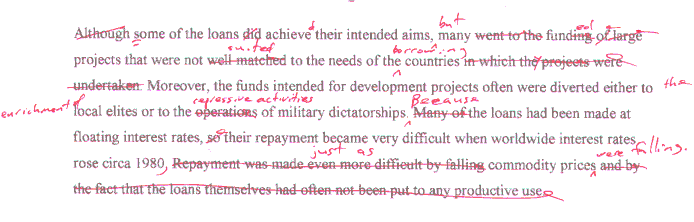
The Detroit State Poems: Marking

Tom Wayman


I begin each essay with a calm mind--
a fresh start.
But as I consider what they have written
I get angry: the most cursory of rereadings
would have caught this sentence fragment,
and here is a misused semicolon
after we spent more than an hour on that in class
and where I talked to this student individually
for another thirty minutes about this persistent mistake.
And instead of the simple structure of the expository paper
which we have also gone over and over
and which can be so helpful a model, a technique, a guide,
here again is a jumbled series of random observations:
trite, contradictory, obviously hurried
and spelled wrong.

My red pencil becomes enraged.
It stalks through the words,
precise, bitter, vindictive,
acting as if it is pleased to discover error
and pounce on it, hacking and destroying and rearranging,
furiously rooting out sloppiness and weakness
as though upholding some stern moral precept
against another, softer age.

But the hand gripping the pencil
begins to tremble with remorse.
It feels it has led the students on
to try to expresss themselves
and then betrayed them:
attacking what they have exposed
of their ideas and emotions.
What use is righteousness, the hand wishes to ask the pencil,
without charity?

I read the name at the top
and think of the young person whose effort this is.
Now all I see on the paper
is a face, crestfallen when I hand back what they attempted.
Eyes look up at me
apprehensively, as at a judge.
We both know my weighing of their skill
will be taken to be an assessment of themselves.

It is as though I have been asked to mark
not essays but their faces,
not sentences but who they are.
I raise my pencil, but my hand still shakes.
I want to show them what in normal English usage
is considered incorrect.
But I can not assign a grade to their eyes.

From: Did I Miss Anything? Selected Poems 1973-1993. Madeira Park, B.C. : Harbour Pub., c1993.

The Student Theme

Ronald Wallace


The adjectives all ganged up on the nouns,
insistent, loud, demanding, inexact,
their Latinate constructions flashing. The pronouns
lost their referents: They were dangling, lacked
the stamina to follow the prepositions' lead
in, on, into, to, toward, for, or from.
They were beset by passive voices and dead
metaphors, conjunctions shouting But! or And!

The active verbs were all routinely modified
by adverbs, that endlessly and colorlessly ran
into trouble with the participles sitting
on the margins knitting their brows like gerunds
(dangling was their problem, too). The author
was nowhere to be seen; was off somewhere.

from The Uses of Adversity, 1998
University of Pittsburgh Press, Pittsburgh, PA

Totally like whatever, you know?

Taylor Mali


In case you hadn't noticed,
it has somehow become uncool
to sound like you know what you're talking about?
Or believe strongly in what you're saying?
Invisible question marks and parenthetical (you know?)'s
have been attaching themselves to the ends of our sentences?
Even when those sentences aren't, like, questions? You know?
Declarative sentences - so-called
because they used to, like, DECLARE things to be true
as opposed to other things which were, like, not -
have been infected by a totally hip
and tragically cool interrogative tone? You know?
Like, don't think I'm uncool just because I've noticed this;
this is just like the word on the street, you know?
It's like what I've heard?
I have nothing personally invested in my own opinions, okay?
I'm just inviting you to join me in my uncertainty?
What has happened to our conviction?
Where are the limbs out on which we once walked?
Have they been, like, chopped down
with the rest of the rain forest?
Or do we have, like, nothing to say?
Has society become so, like, totally . . .
I mean absolutely . . . You know?
That we've just gotten to the point where it's just, like . . .
whatever!
And so actually our disarticulation . . . ness
is just a clever sort of . . . thing
to disguise the fact that we've become
the most aggressively inarticulate generation
to come along since . . .
you know, a long, long time ago!
I entreat you, I implore you, I exhort you,
I challenge you: To speak with conviction.
To say what you believe in a manner that bespeaks
the determination with which you believe it.
Because contrary to the wisdom of the bumper sticker,
it is not enough these days to simply QUESTION AUTHORITY.
You have to speak with it, too.

The Printer's Error

Aaron Fogel

Here is a poem about typographical errors.


Fellow compositors
and pressworkers!

I, Chief Printer
Frank Steinman,
having worked fifty-
seven years at my trade,
and served five years
as president
of the Holliston
Printer's Council,
being of sound mind
though near death,
leave this testimonial
concerning the nature
of printers' errors.

First: I hold that all books
and all printed
matter have
errors, obvious or no,
and that these are their
most significant moments,
not to be tampered with
by the vanity and folly
of ignorant, academic
textual editors.
Second: I hold that there are
three types of errors, in ascending
order of importance:
One: chance errors
of the printer's trembling hand
not to be corrected incautiously
by foolish professors
and other such rabble
because trembling is part
of divine creation itself.

Two: silent, cool sabotage
by the printer,
the manual laborer
whose protests
have at times taken this
historical form,
covert interferences
not to be corrected
censoriously by the hand
of the second and far
more ignorant saboteur,
the textual editor.
Three: errors
from the touch of God,
divine and often
obscure corrections
of whole books by
nearly unnoticed changes
of single letters
sometimes meaningful but
about which the less said
by preemptive commentary
the better.
Third: I hold that all three
sorts of error,
errors by chance,
errors by workers' protest,
and errors by
God's touch,
are in practice the
same and indistinguishable.

Therefore I,
Frank Steinman,
typographer
for thirty-seven years,
and cooperative Master
of the Holliston Guild
eight years,
being of sound mind and body
though near death
urge the abolition
of all editorial work
whatsoever
and manumission
from all textual editing
to leave what was
as it was, and
as it became,
except insofar as editing
is itself an error, and

therefore also divine.

from The Printer's Error, 2001
Miami University Press, Oxford, Ohio

Publication Date

Franz Wright


One of the few pleasures of writing
is the thought of one’s book in the hands of a kind-hearted
intelligent person somewhere. I can’t remember what the others are right now.
I just noticed that it is my own private

National I Hate Myself and Want to Die Day
(which means the next day I will love my life
and want to live forever). The forecast calls
for a cold night in Boston all morning

and all afternoon. They say
tomorrow will be just like today,
only different. I’m in the cemetery now
at the edge of town, how did I get here?

A sparrow limps past on its little bone crutch saying
I am Frederico Garcia Lorca
risen from the dead–
literature will lose, sunlight will win, don’t worry.

From FIELD: Contemporary Poetry and Poetics, vol. 70, 2004
Oberlin College Press

Words Aren’t Just Tools

Anne Carolyn Klein


Words aren’t just tools
For getting things straight
Pinning them down
Holding them up

Don’t use them like hammers
Or even as thumbtacks.

Don’t merely handle them.

Hold them, melt them to your marrow
From where,
Nourishing your heart,
Loving your soul,
They rise again, aloft from your lungs,
Flowing out graciously
Helping the world exist.

The Unwritten Pages

Megan G.


I know
That somewhere
Are the words that remain invisible
They would love to sing
But they have no voice
They would love to breathe
But they have no air
So they wander
Unheard
Like music without a staff
And I know
Sometime
I will find those words
Help them sing and help them breathe
My pen will no longer remain still
My soul no longer
Unwritten

Kind Dove Sky

Paul W. Hankins


The Monday blackboard reads:
“Describe the sky –”
the simplest of tasks
for the accomplished writer –

blue lines contained in word clouds
sun orange sprinkled effect streaking
waiting rains remember when they hailed
and ruled the green the flower the river

but for the Wednesday writer,
in the desk brand new,
writing tablet and pencil sharpened,
it almost always sounds forced – for example:

It's a kind of sky
like God twisted and twirled it up blue and pink
on a paper cone and handed it to me
to eat on a bench by the Ferris wheel
and I wipe clouds from the corners
of my mouth with sticky hands.

or worse yet, if the reader will allow
for the child who has read
or has been read to:

It's a kind of sky
where cherubim wear clouds for dresses
and rainbow barrettes pin angel hair behind ears
listening for the songs of birds
who have forgotten the hymns
they were taught so they whistle
praises into thin air.

So, you see the problem –
this leaving of prompts regarding the sky –
left on blackboards for responses by children:

It’s always reduced to poetry and image;

The child should know a reverence
of space and atmosphere by rote,
through choral recitation,
a mentor text of the Maker
that would sound like this:

It was a kind dove sky
reminding us of when we could fly
and blue was not reeling
but a becoming one with a feeling
of owning for ourselves once again
what we gave away to angels and has since
been called Heaven.

It begs the question:

What on earth are we teaching?

And what am I to do,
if I am ever going to teach this way,
when I lift my head heavenward
and see nothing – nothing –
but kind-ofs
in the sky above?

Don't Be Afraid

by Rob, Grade 10


Writing poetry
Is not as daunting as it sounds.
All you have to have done
To write poetry
Is to have lived.

I’m alive,
So I can write poetry.
Anyone reading this is presumably alive;
Therefore, you too
Are capable of writing poetry.

Once you establish
That you are, in fact, alive,
Your poetry may be governed
By your mood. If you’re hungry,
For example, there’s an excellent chance
That your poem will reflect your hunger.

Some choose to be coy with their meanings
And highfalutin’ with their language
(“Bubbles in an IV loitering” or
“Museums mark their bodies down”)

This is okay sometimes,
But you don’t want to hide
Your poem’s meaning
From the reader altogether.

Do you understand now
Why writing poetry is not as hard
As you thought?

Proof of life, mood, language:
Three simple steps
And your poetry
Will flow
Like water.

Do You Have Any Advice For Those of Us Just Starting Out?

Ron Koertge


Give up sitting dutifully at your desk. Leave
your house or apartment. Go out into the world.

It's all right to carry a notebook but a cheap
one is best, with pages the color of weak tea
and on the front a kitten or a space ship.

Avoid any enclosed space where more than
three people are wearing turtlenecks. Beware
any snow-covered chalet with deer tracks
across the muffled tennis courts.

Not surprisingly, libraries are a good place to write.
And the perfect place in a library is near an aisle
where a child a year or two old is playing as his
mother browses the ranks of the dead.

Often he will pull books from the bottom shelf.
The title, the author's name, the brooding photo
on the flap mean nothing. Red book on black, gray
book on brown, he builds a tower. And the higher
it gets, the wider he grins.

You who asked for advice, listen: When the tower
falls, be like that child. Laugh so loud everybody
in the world frowns and says, "Shhhh."

Then start again.

Digging

Seamus Heaney


       Between my finger and my thumb
The squat pen rests; as snug as a gun.

Under my window a clean rasping sound
When the spade sinks into gravelly ground:
My father, digging. I look down

Till his straining rump among the flowerbeds
Bends low, comes up twenty years away
Stooping in rhythm through potato drills
Where he was digging.

The coarse boot nestled on the lug, the shaft
Against the inside knee was levered firmly.
He rooted out tall tops, buried the bright edge deep
To scatter new potatoes that we picked
Loving their cool hardness in our hands.

By God, the old man could handle a spade,
Just like his old man.

My grandfather could cut more turf in a day
Than any other man on Toner's bog.
Once I carried him milk in a bottle
Corked sloppily with paper. He straightened up
To drink it, then fell to right away
Nicking and slicing neatly, heaving sods
Over his shoulder, digging down and down
For the good turf. Digging.

The cold smell of potato mold, the squelch and slap
Of soggy peat, the curt cuts of an edge
Through living roots awaken in my head.
But I've no spade to follow men like them.

Between my finger and my thumb
The squat pen rests.
I'll dig with it.