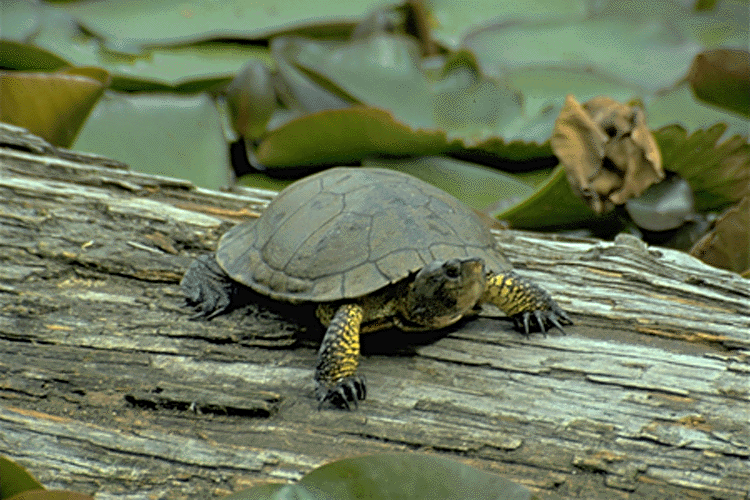
Kay Ryan
Who would be a turtle who could help it?
A barely mobile hard roll, a four-oared helmet,
She can ill afford the chances she must take
In rowing toward the grasses that she eats.
Her track is graceless, like dragging
A packing-case places, and almost any slope
Defeats her modest hopes. Even being practical,
She’s often stuck up to the axle on her way
To something edible. With everything optimal,
She skirts the ditch which would convert
Her shell into a serving dish. She lives
Below luck-level, never imagining some lottery
Will change her load of pottery to wings.
Her only levity is patience,
The sport of truly chastened things.
From Flamingo Watching
Copper Beach Press, 1994
Showing posts with label Animals. Show all posts
Ode to a Toad
Anne-Marie Wulfsberg
I was out one day for my usual jog,
(I go kinda easy, rarely full-hog)
When I happened to see, right there on the road
The squishy remains of a little green toad.
I thought to myself, where is his home?
Down yonder green valley, how far did he roam?
From out on the pond I heard sorrowful croaks,
Could that be the wailing of some of his folks?
I felt for the toad and his pitiful state,
But the day was now fading, and such was his fate.
In the grand scheme of things, now I confess,
What's one little froggie, more or less?
I was out one day for my usual jog,
(I go kinda easy, rarely full-hog)
When I happened to see, right there on the road
The squishy remains of a little green toad.
I thought to myself, where is his home?
Down yonder green valley, how far did he roam?
From out on the pond I heard sorrowful croaks,
Could that be the wailing of some of his folks?
I felt for the toad and his pitiful state,
But the day was now fading, and such was his fate.
In the grand scheme of things, now I confess,
What's one little froggie, more or less?
A Narrow Fellow in the Grass
Emily Dickinson
A narrow fellow in the grass
Occasionally rides;
You may have met him,--did you not,
His notice sudden is.
The grass divides as with a comb,
A spotted shaft is seen;
And then it closes at your feet
And opens further on.
He likes a boggy acre,
A floor too cool for corn.
Yet when a child, and barefoot,
I more than once, at morn,
Have passed, I thought, a whip-lash
Unbraiding in the sun,--
When, stooping to secure it,
It wrinkled, and was gone.
Several of nature's people
I know, and they know me;
I feel for them a transport
Of cordiality;
But never met this fellow,
Attended or alone,
Without a tighter breathing,
And zero at the bone.
A narrow fellow in the grass
Occasionally rides;
You may have met him,--did you not,
His notice sudden is.
The grass divides as with a comb,
A spotted shaft is seen;
And then it closes at your feet
And opens further on.
He likes a boggy acre,
A floor too cool for corn.
Yet when a child, and barefoot,
I more than once, at morn,
Have passed, I thought, a whip-lash
Unbraiding in the sun,--
When, stooping to secure it,
It wrinkled, and was gone.
Several of nature's people
I know, and they know me;
I feel for them a transport
Of cordiality;
But never met this fellow,
Attended or alone,
Without a tighter breathing,
And zero at the bone.
Love Song
Carol Muske-Dukes
Love comes hungry to anyone’s hand.
I found the newborn sparrow next to
the tumbled nest on the grass. Bravely
opening its beak. Cats circled, squirrels.
I tried to set the nest right but the wild
birds had fled. The knot of pin feathers
sat in my hand and spoke. Just because
I’ve raised it by touch, doesn’t mean it
follows. All day it pecks at the tin image of
a faceless bird. It refuses to fly,
though I’ve opened the door. What
sends us to each other? He and I
had a blue landscape, a village street,
some poems, bread on a plate. Love
was a camera in a doorway, love was
a script, a tin bird. Love was faceless,
even when we’d memorized each other’s
lines. Love was hungry, love was faceless,
the sparrow sings, famished, in my hand.
Love comes hungry to anyone’s hand.
I found the newborn sparrow next to
the tumbled nest on the grass. Bravely
opening its beak. Cats circled, squirrels.
I tried to set the nest right but the wild
birds had fled. The knot of pin feathers
sat in my hand and spoke. Just because
I’ve raised it by touch, doesn’t mean it
follows. All day it pecks at the tin image of
a faceless bird. It refuses to fly,
though I’ve opened the door. What
sends us to each other? He and I
had a blue landscape, a village street,
some poems, bread on a plate. Love
was a camera in a doorway, love was
a script, a tin bird. Love was faceless,
even when we’d memorized each other’s
lines. Love was hungry, love was faceless,
the sparrow sings, famished, in my hand.
To Help the Monkey Cross the River
Thomas Lux

To help the monkey cross the river,
which he must
cross, by swimming, for fruits and nuts,
to help him
I sit with my rifle on a platform
high in a tree, same side of the river
as the hungry monkey. How does this assist
him? When he swims for it
I look first upriver: predators move faster with
the current than against it.
If a crocodile is aimed from upriver to eat the monkey
and an anaconda from downriver burns
with the same ambition, I do
the math, algebra, angles, rate-of-monkey,
croc- and snake-speed, and if, if
it looks as though the anaconda or the croc
will reach the monkey
before he attains the river’s far bank,
I raise my rifle and fire
one, two, three, even four times into the river
just behind the monkey
to hurry him up a little.
Shoot the snake, the crocodile?
They’re just doing their jobs,
but the monkey, the monkey
has little hands like a child’s,
and the smart ones, in a cage, can be taught to smile.
From The Cradle Place Houghton Mifflin, 2004

To help the monkey cross the river,
which he must
cross, by swimming, for fruits and nuts,
to help him
I sit with my rifle on a platform
high in a tree, same side of the river
as the hungry monkey. How does this assist
him? When he swims for it
I look first upriver: predators move faster with
the current than against it.
If a crocodile is aimed from upriver to eat the monkey
and an anaconda from downriver burns
with the same ambition, I do
the math, algebra, angles, rate-of-monkey,
croc- and snake-speed, and if, if
it looks as though the anaconda or the croc
will reach the monkey
before he attains the river’s far bank,
I raise my rifle and fire
one, two, three, even four times into the river
just behind the monkey
to hurry him up a little.
Shoot the snake, the crocodile?
They’re just doing their jobs,
but the monkey, the monkey
has little hands like a child’s,
and the smart ones, in a cage, can be taught to smile.
From The Cradle Place Houghton Mifflin, 2004
Remora, Remora
Thomas Lux

Clinging to the shark
is a sucker shark,
attached to which
and feeding off its crumbs
is one still tinier,
inch or two,
and on top of that one,
one the size of a nick of gauze;
smaller and smaller
(moron, idiot, imbecile, nincompoop)
until on top of that
is the last, a microdot sucker shark,
a filament’s tip – with a heartbeat – sliced off,
and the great sea
all around feeding
his host and thus him.
He’s too small
to be eaten himself
(though some things swim
with open mouths) so
he just rides along in the blue current,
the invisible point of the pyramid,
the top beneath all else.
From The Cradle Place
Houghton Mifflin, 2004

Clinging to the shark
is a sucker shark,
attached to which
and feeding off its crumbs
is one still tinier,
inch or two,
and on top of that one,
one the size of a nick of gauze;
smaller and smaller
(moron, idiot, imbecile, nincompoop)
until on top of that
is the last, a microdot sucker shark,
a filament’s tip – with a heartbeat – sliced off,
and the great sea
all around feeding
his host and thus him.
He’s too small
to be eaten himself
(though some things swim
with open mouths) so
he just rides along in the blue current,
the invisible point of the pyramid,
the top beneath all else.
From The Cradle Place
Houghton Mifflin, 2004
Subscribe to:
Posts (Atom)


